This is the result of session 8 in my course on Social Robot Design (2025/2026). The content of this session was mainly about putting everything of the game together. We thought of the cards, how they would look etc. How we can make our booklet and poster. And also the video. Over the next few weeks we actually printed and made everything.
Session 8
Planning the deliverables
Before session 8, we had already puppeteered Miro and written step-by-step guidelines for puppetering. This session was about turning that work into three deliverables: a booklet, a poster, and a video.
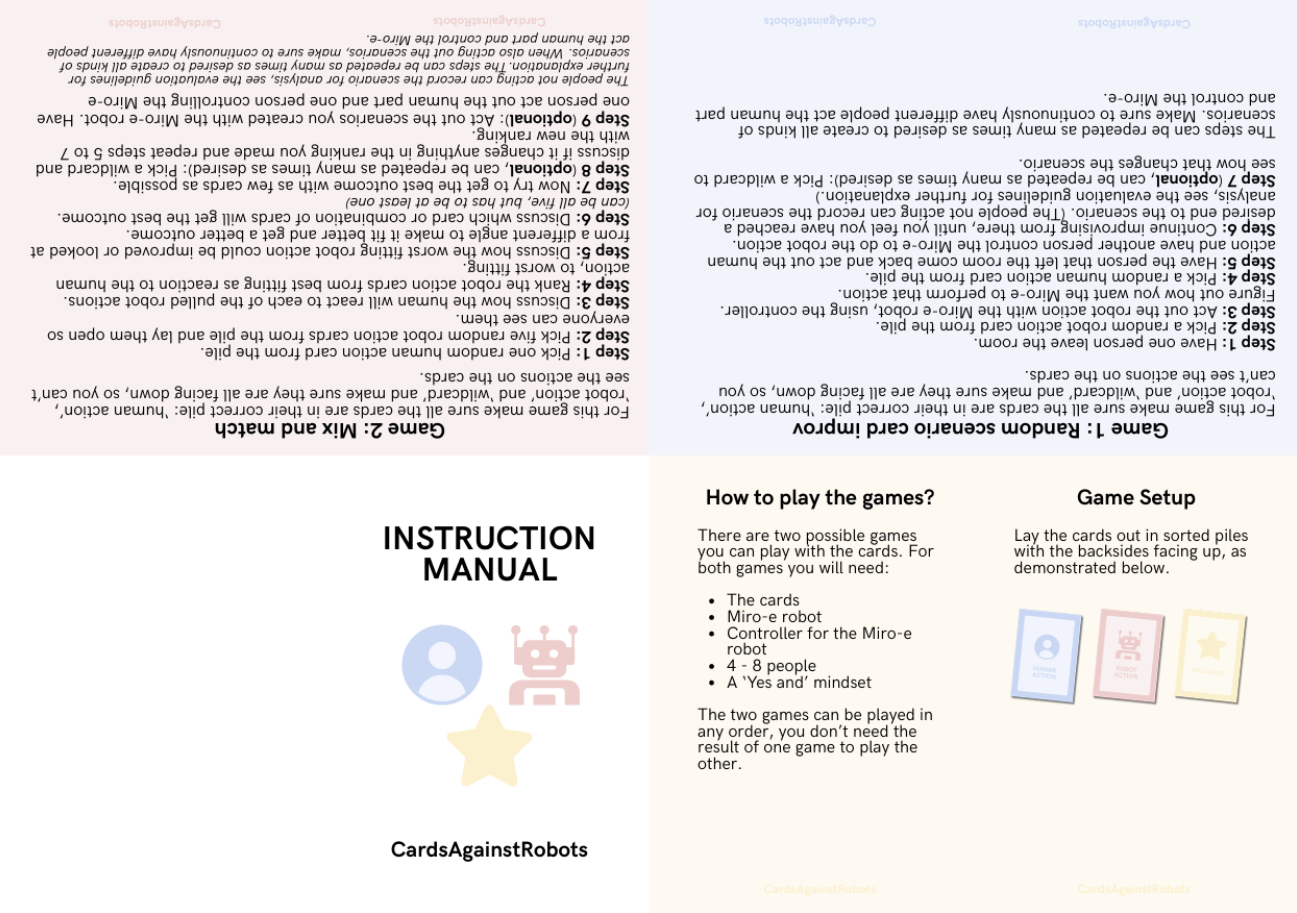
Booklet
The booklet needed to bring together you would need to play the game. It had to contain:
- Game guidelines
- Evaluation guidelines
- An evaluation form (with a QR code linking to more copies)
- section on how to use the evaluation results
- All of the above combined into one document
The booklet is meant to fold:
Evaluation form
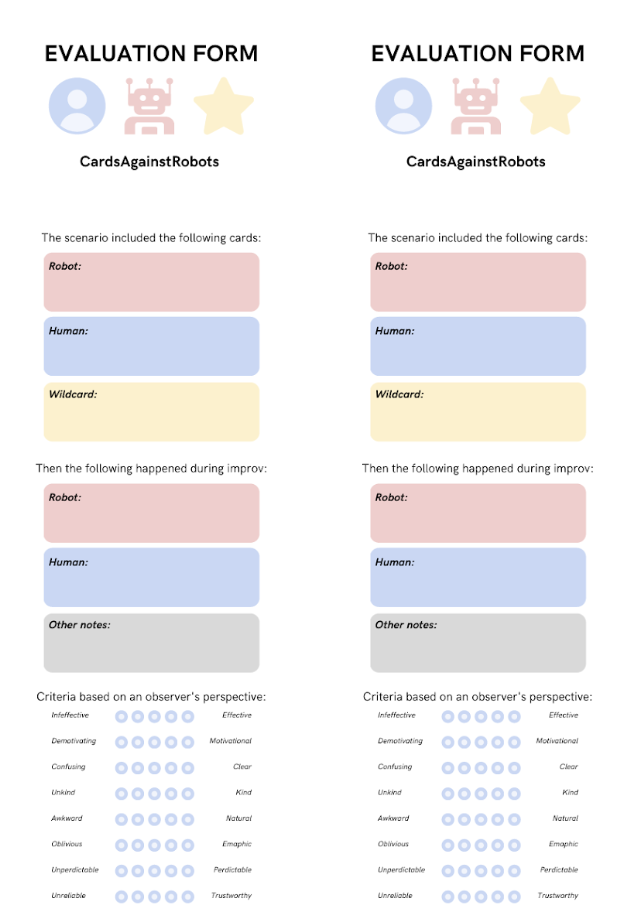
Alongside the game itself, we designed an evaluation form to capture feedback on the robot design choices made during a session. The form was kept short and structured, so it could be filled in quickly right after playing.
Poster
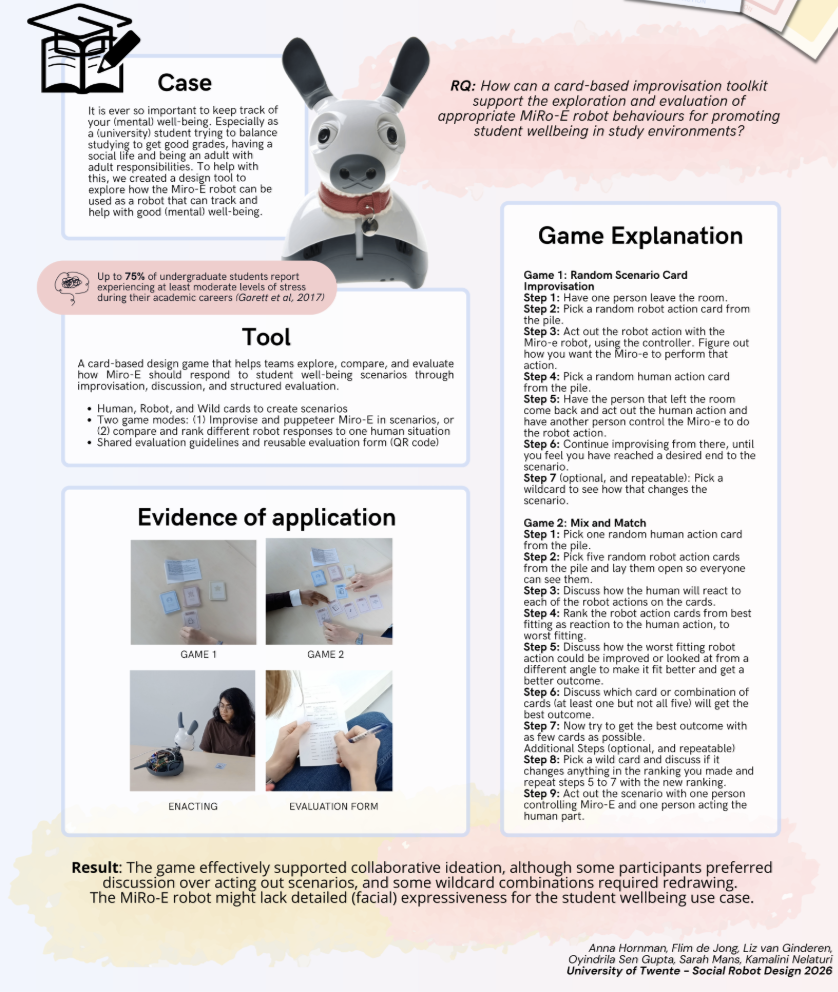
For the poster we brought together the case, our research question, the tool itself, and how the game works. We added photos of the cards, the puppeteering, and someone filling in the evaluation form to show it in actual use. We ended with a short result: the game worked well for getting people to think together, though some liked discussing more than acting things out, a few wildcard combos needed a redraw, and MiRo-E’s lack of facial expressiveness turned out to be a limitation for the wellbeing use case.
Video
The video is divided into a 4-part structure, with each content point capped at roughly 75 seconds:
- The challenge — keeping track of mental wellbeing while studying. We introduce Miro-E, designed to support student wellbeing.
- Tool demonstration. Failures and how we solved them.
The wildcard sometimes didn’t clearly change anything, or produced a totally unrelated outcome. We resolved this by treating a “no effect” result as valid information in itself, or simply drawing another card. We could only include a limited number of physical evaluation forms in the booklet, so we added a QR code. Puppeteering the Miro-E robot worked well for quick improvisation, but was not suited to evaluating final design choices because it wasn’t so easy to puppeteer (technically wise because you had to hook up a computer)
- Evaluation — did the robot design actually improve, and did the tool itself work as intended?
The video itself is handed in as a delivarable.
We had a list of To Dos, which basically highlight all the tasks we were going to do.
To Do
- Puppeteer Miro
- Create guidelines for puppetering (Step-by-step)
- Work out plan for prototyping, poster and video
Booklet plan
- Game guidelines in correct style
- Evaluation guidelines in correct style
- Evaluation form in correct style (+ qr to more)
- Evaluation results use in correct style
- Put instructions together in single booklet
Poster ideas
landscape - on a huge screen (a0? a1?)
- Put some example cards on there
- Give it a name
- Add stylistic elements same as cards
Case and tool identifiable
- Make them clear, big? in center?
Tool structure is visualised
- cards
- game explanation in short
- evaluation explanation in short
evidence of application
- images of tool in use
poster production quality
- readable layout, …
Video ideas
Challenge
- Keeping track of mental wellbeing during studying/as a student
- This is Miro-E. Miro-E is designed to help your well-being!
Tool demonstration
- use of cards
- both games?
- use of evaluation form
Failure/unexpected finding → solved how
- Wildcard doesn’t match (doesn’t change anything/ does totally different) → realize it has no effect on the situation, and/or pick another one
- Evaluation forms included only limited → people can print their own with QR
- Miro-E robot only puppeteering → works well for quick improv, but still not as good for evaluating final design choices. (more of an explorative tool)
Evaluation of design outcome
- Did the robot design improve?
Evaluation of the tool quality
- Did the tool work?
Movie quality
- sound clear, visuals stable, max 5 minutes
4 content points for in the video, 5 min max, max 75 seconds per content point
This was done with:
- Liz van Ginderen (s27349745)
- Anna Hornman (s3056600)
- Oyindrila Sen Gupta (s3697762)
- Sarah Mans (s2306379)